
Identify Your Pest Crawling insects Cellar spider
Cellar spider
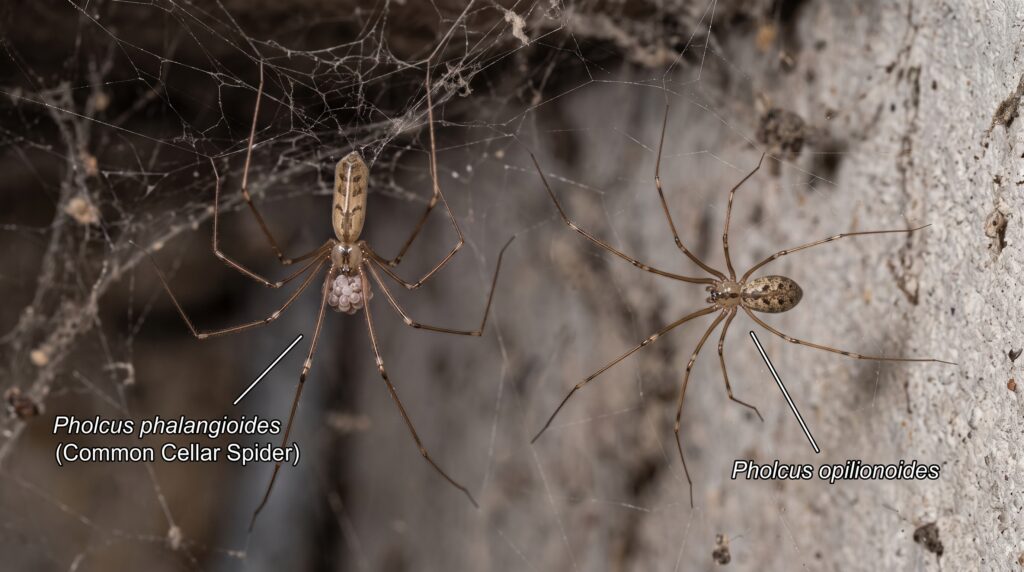
Pholcus phalangioides and P. opilionoides · Also called: Daddy long-legs spider, long-bodied cellar spider
Cellar spiders are pale, delicate spiders with very long, thin legs that hang upside down in loose webs in basements, garages and ceiling corners. People notice them because of their long legs and untidy webs, but they are harmless to people.
Size Body about 3 to 9 mm, with much longer legs
Colour Pale beige to light grey, sometimes with faint grey marks
Key feature Very long, hair-thin legs; shakes rapidly in its web when disturbed
Season Indoors year round; also on house exteriors in summer
Where Basement ceilings, crawl spaces, garages, closets, window frames and eaves
What it looks like
Cellar spiders have a small, pale body and extremely long, thin legs, so they look fragile. The long-bodied cellar spider has a narrow, tube-shaped abdomen and legs about five to six times its body length. The harvestman cellar spider, also found in Alberta, looks similar but is smaller.
Both hang upside down in loose, untidy webs, often in ceiling corners. When disturbed, many shake or whirl so fast they become a blur. A female carries her small, round egg sac in her jaws instead of leaving it in the web. The eggs can often be seen through the thin silk.
Often confused with
Harvestman
Crane fly
Cobweb spiders
Signs to look for
Loose ceiling webs
A spider that shakes in its web
Egg sac held in the jaws
Wrapped prey
Many spiders in one area
Risks and damage
Cellar spiders are harmless to people. There is no evidence that their venom is dangerous to humans, and bites are extremely rare. They do not damage the home, food or belongings. The main issue is how they look: webs and spiders in basements, garages and storage rooms. Large numbers can point to other insects or spiders indoors, since cellar spiders feed on them.
In Alberta
Cellar spiders in Alberta homes are introduced species that live mainly in and on buildings. The long-bodied cellar spider is recorded in Edmonton, Calgary and Red Deer. The harvestman cellar spider was first confirmed near Edmonton in 2021, where a female with an egg sac was found on a house.
Spiders collected at a house near Edmonton helped confirm the first formal Canadian record of the harvestman cellar spider in 2021. At the time, they were the most northern known records of it in North America.
How to keep them out
Lower basement humidity
Vacuum webs and egg sacs
Declutter storage areas
Seal entry points
Reduce insect prey
When it is time to bring in a professional
A few cellar spiders are normal and even help by eating other pests. Consider a professional if webs and spiders keep spreading through a basement, rental unit or commercial space, or if large numbers suggest an insect problem feeding them. Technica’s licensed technicians can identify the spiders and find the source.
Frequently asked questions
Are cellar spiders the most venomous spiders in the world?
No. This is a popular myth. There is no evidence that cellar spider venom is dangerous to people, and they almost never bite. They are timid and would rather shake in their web or run away.
Are cellar spiders the same as daddy long-legs?
It depends who you ask. Cellar spiders are true spiders that spin webs indoors. Harvestmen are outdoor arachnids with one oval body, and they make no silk. Crane flies are long-legged insects with wings. People call all three daddy long-legs.
Should I leave cellar spiders alone?
A few can be left in a basement or garage, since they catch insects and other spiders. If you would rather not share your space, vacuum the spiders, webs and egg sacs. Reducing clutter, moisture and indoor insects helps keep numbers down.