
Identify Your Pest Crawling insects House centipede
House centipede
Scutigera coleoptrata
The house centipede is a fast, long-legged hunter that, in cold climates, lives mostly inside heated buildings. It is rarely reported in Alberta, where the centipede most often recorded is the shorter-legged brown stone centipede.
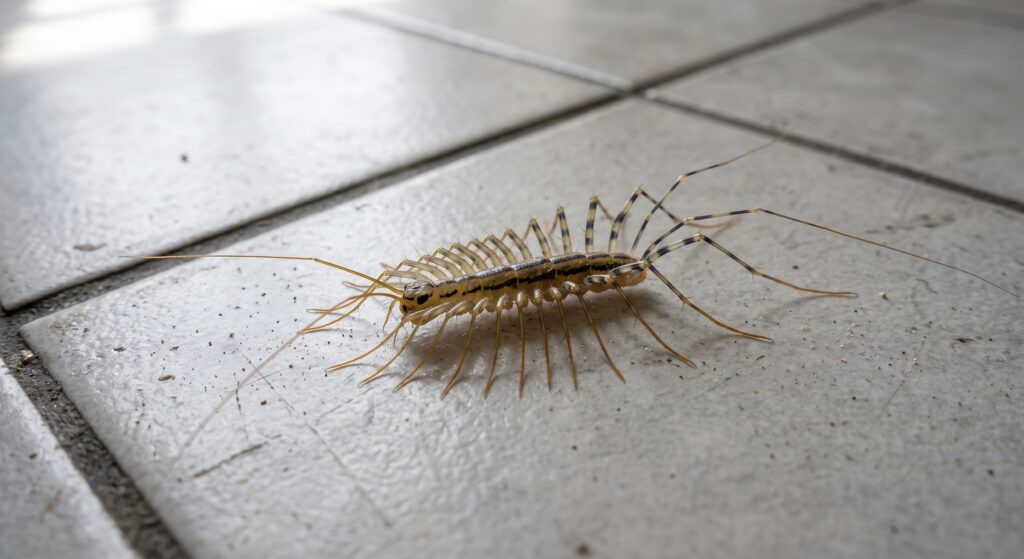
Size Body about 25 to 35 mm; legs add much more
Colour Yellowish grey with three dark stripes and banded legs
Key feature 15 pairs of very long, thin legs and antennae longer than its body
Season Year round indoors in heated, damp spaces
Where Damp basements, bathrooms, floor drains, laundry rooms and crawl spaces
What it looks like
The house centipede has a short, yellowish grey body with three dark stripes running down the back. Adults have 15 pairs of very long, thin legs with dark bands. The antennae are longer than the body, and the last pair of legs is so long it can look like a second set of antennae.
It runs very fast, often in short bursts, and hides in dark, damp spots by day. In Alberta, look closely at the legs. A reddish brown centipede with short, sturdy legs is most likely a stone centipede, not a house centipede.
Often confused with
Brown stone centipede
Millipede
Signs to look for
Fast runners at night
Centipedes in sinks or tubs
Damp, cluttered storage
Other small bugs nearby
Risks and damage
House centipedes are mostly a nuisance and a sign of dampness. They hunt insects, spiders and silverfish, and they do not damage wood, food or fabric. They would rather run than bite. Their jaws are small and made for insects, so people are seldom bitten, and a bite usually causes only brief, mild pain. They do not spread disease.
In Alberta
House centipedes are on Alberta’s species list as an introduced species, but records here are scarce. Where winters are cold, they mostly stay indoors. The centipede most often recorded in Edmonton, Calgary and across Alberta is the brown stone centipede. Both point to damp spots with prey.
A newly hatched house centipede has only four pairs of legs. It gains more pairs each time it moults until it reaches the full adult set of 15 pairs.
How to keep them out
Dry out the basement
Clear clutter
Seal cracks and gaps
Cut down their food
Keep firewood outside
When it is time to bring in a professional
Professional help is worth it if you see centipedes often, if you are not sure which kind you have, or if they point to an ongoing damp or insect problem. Finding what they are feeding on is usually the key. Technica’s licensed technicians can identify the centipede and check what is drawing it in.
Frequently asked questions
Are house centipedes dangerous?
No. A house centipede would rather run from you than bite. One that is trapped against your skin may nip, and the spot can sting and look a little red for a short time. They do not spread disease or damage your home.
Is the centipede in my Alberta basement a house centipede?
Probably not. House centipedes are rarely reported in Alberta. If your centipede is reddish brown with short, sturdy legs, it is most likely a stone centipede. A clear photo can help confirm which kind you have.
Why do centipedes come into my house?
They look for moisture, shelter and food. Damp basements, bathrooms and cluttered storage areas with other small insects give them all three.