Identify Your Pest Crawling insects Common house spider
Common house spider
Parasteatoda tepidariorum · Also called: American house spider
The common house spider is a small cobweb spider that builds messy, tangled webs in quiet corners of buildings. It is rarely confirmed in Alberta, where related cobweb spiders such as the boreal combfoot are recorded far more often.
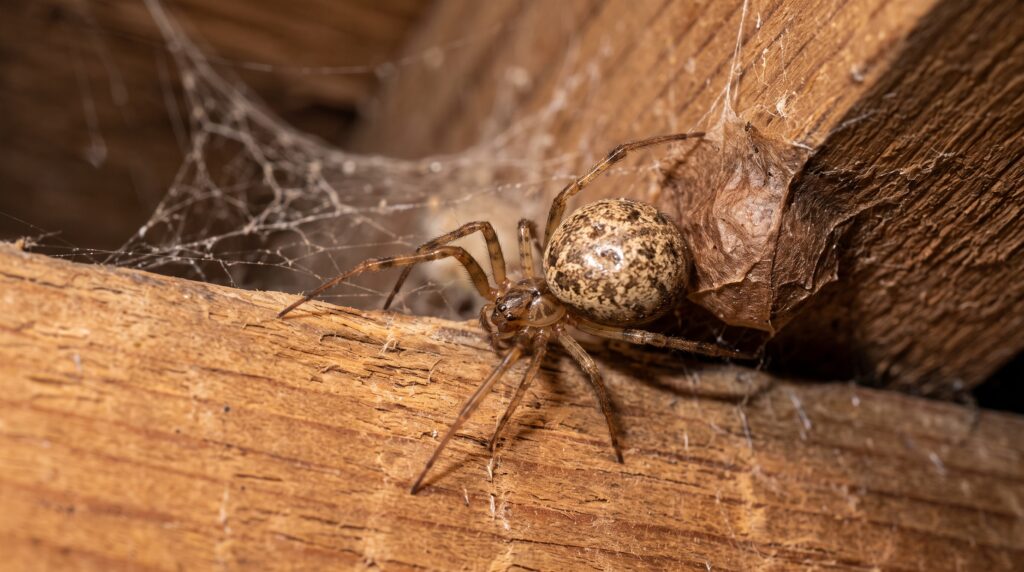
Size About 4 to 8 mm long, not counting legs
Colour Yellowish brown to grey with darker mottling; banded legs
Key feature Round, ball-shaped abdomen; hangs upside down in a messy tangle web
Season Year round indoors; outdoors on sheds and eaves in summer
Where Quiet corners of basements, garages and storage rooms; window sills; eaves
What it looks like
The common house spider is small, with a round, high abdomen that looks like a tiny ball. The body is usually yellowish brown to grey with darker, blotchy markings, and the thin legs have darker rings at the joints. Females are larger than males and rarely leave the web.
The web is the easiest clue. It is a loose, three-dimensional tangle in an upper corner, a window frame or under a shelf. The spider hangs upside down near the middle or hides in debris at the edge. Look for small, brown, teardrop-shaped egg sacs hanging in the web. Old webs collect dust and become the grey cobwebs people sweep away.
Often confused with
Western black widow
Boreal combfoot
Cellar spider
Signs to look for
Tangled corner webs
Brown egg sacs
Insect remains
Dusty cobwebs
Risks and damage
The common house spider is a nuisance, not a danger. It is shy and bites are rare. A bite usually causes only mild, short-lived irritation, though a person with allergies could react more strongly. It does not damage wood, food or fabric. The main problem is the look of webs and egg sacs in corners, windows and storage areas. Lots of webs can also point to a steady supply of small insects indoors.
In Alberta
This spider lives in and around buildings in southern Canada, but it is rarely confirmed in Alberta, with only a few verified records, such as in Edmonton. Relatives like the boreal combfoot are recorded far more often here and build similar tangled webs.
Scientists around the world use the common house spider as a model animal to study how bodies develop. It is easy to raise in a lab and lays many eggs.
How to keep them out
Vacuum webs and egg sacs
Cut down on indoor insects
Seal cracks and gaps
Store items in sealed bins
Rethink outdoor lights
When it is time to bring in a professional
A few cobweb spiders are normal in most homes and are easy to vacuum up. Consider a professional if webs keep coming back in many rooms or you manage a building with a wider problem. It also helps if you think a spider may be a black widow. Technica’s licensed technicians can identify it and find what attracts it.
Frequently asked questions
Is the common house spider dangerous?
No. It is not considered medically important. It is shy and bites are rare. Most cause only mild irritation, though a rare person may react more strongly. Wash any bite with soap and water. See a doctor if it becomes more painful, swollen or red over the next few days, or if you feel unwell.
Why do the webs keep coming back after I clean?
House spiders often abandon a web and build a new one nearby, so webs can appear quickly. Egg sacs left behind can also hatch. Vacuum egg sacs as well as webs, cut down on the small insects spiders feed on, and seal gaps where new spiders get in.
Could this spider be a black widow?
Probably not. In Alberta, black widows are found mainly in dry parts of the south. A female black widow is glossy black with a red hourglass under the abdomen. The common house spider is dull brown or grey and mottled. If you are unsure, keep your distance and have it identified.