
Identify Your Pest Crawling insects Carpet beetle
Carpet beetle
Anthrenus spp., Attagenus spp. · Also called: Varied carpet beetle, black carpet beetle
Carpet beetles are tiny, rounded beetles whose fuzzy larvae chew wool, fur, feathers, silk and other animal fibres. Most people notice the adults on windowsills in spring or find small holes and bristly shed skins in rugs, closets and stored clothing.
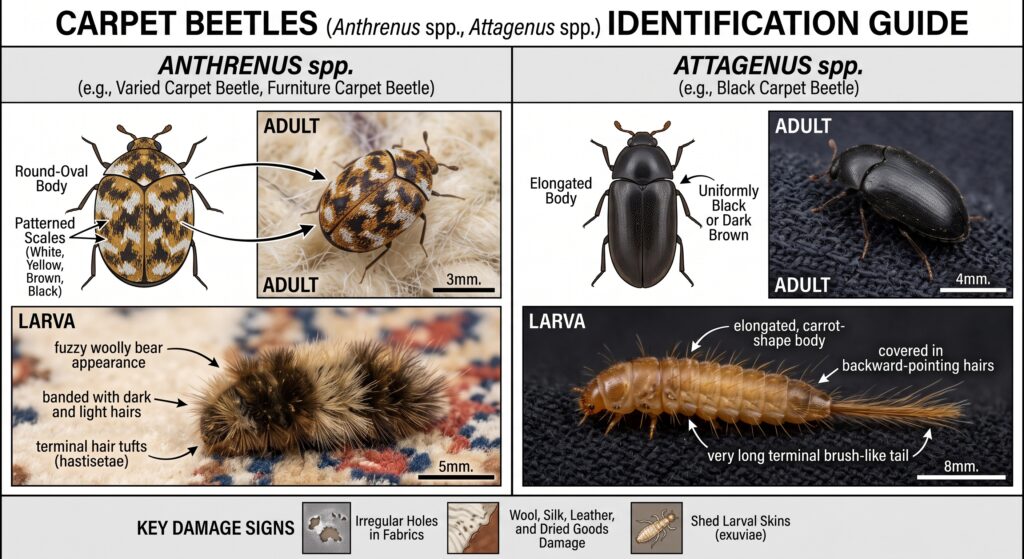
Size Adults 2 to 5 mm; larvae up to about 9 mm
Colour Adults mottled white, brown and yellow, or solid black
Key feature Tiny oval beetle, solid black or speckled; larvae hairy with a tail tuft
Season Adults seen spring to early summer; larvae feed indoors year round
Where Windowsills, closets, rugs, under furniture and in stored wool or furs
What it looks like
Two kinds turn up most in homes. City of Edmonton advice names the black carpet beetle as the one found most often locally. It is a plain black or very dark brown, egg-shaped beetle no longer than about 5 mm. The varied carpet beetle is smaller, 2 to 3 mm, round and mottled with white, brown and yellow scales. Both kinds fly and head for bright windows.
The larvae do the damage. A black carpet beetle larva looks like a tiny golden-brown brush that tapers to a long tassel of rear hairs. Varied carpet beetle larvae are small, fuzzy and banded brown, with bristle tufts at the rear. Larvae keep to dark, undisturbed spots and leave empty, bristly shed skins behind.
Often confused with
Bed bug
Lady beetle (ladybug)
Clothes moth larva
Signs to look for
Beetles on windowsills
Holes in natural fabrics
Bristly shed skins
Fuzzy larvae
Risks and damage
Carpet beetles do not bite and do not spread disease. The larvae damage wool rugs, clothing, furs, feathers, silk, upholstery and items such as taxidermy mounts. In some people, the tiny hairs on the larvae cause an itchy rash that can be mistaken for bites. Otherwise they are mainly a property pest, and the damage is usually slow and limited when it is found early.
In Alberta
Carpet beetles are found in homes across Alberta, including Edmonton and Calgary. Adults feed on flower pollen outdoors and fly in through open windows or ride in on cut flowers in spring and summer. Their larvae can then feed indoors for many months, right through the winter.
Carpet beetle larvae can take anywhere from a few months to more than a year to become adults, depending on warmth and food. That is why a small problem can go unnoticed for a long time.
How to keep them out
Vacuum hidden edges
Clean before storing
Use sealed storage
Remove old nests
Screen windows
When it is time to bring in a professional
Call a professional when larvae keep turning up after cleaning, when damage appears in several rooms, or when valuable rugs, clothing or heirlooms are at risk. Finding the source, such as a hidden nest or old stored items, is key. Technica’s licensed technicians can inspect and treat the areas you cannot reach.
Frequently asked questions
Do carpet beetles bite?
No. Carpet beetles do not bite or feed on people. Some people get an itchy rash from contact with the tiny hairs on the larvae, and it can look like bites. If you have unexplained itchy bumps and also find carpet beetle larvae, they may be the cause.
Why do I see carpet beetles on my windows?
Adult carpet beetles are drawn to light. Beetles that grew up indoors fly to windows trying to get outside to feed on flower pollen. Finding several on sills in early spring, before windows are opened, is a good reason to check closets, rugs and stored woollens.
Do carpet beetles eat synthetic carpets?
Larvae mainly eat animal-based materials such as wool, silk, fur, feathers and leather. Pure synthetic fabrics are rarely eaten, but wool blends, or synthetics soiled with food, sweat or pet hair, can be damaged.