Identify Your Pest Crawling insects Carpenter ant
Carpenter ant
Camponotus spp.
Carpenter ants are large black ants that chew out nests in damp or softened wood. Homeowners usually notice them when big ants wander indoors, winged ants gather near windows, or small piles of sawdust appear below trim.
Size Workers 6 to 13 mm; queens larger
Colour Black, or black with a dark reddish thorax
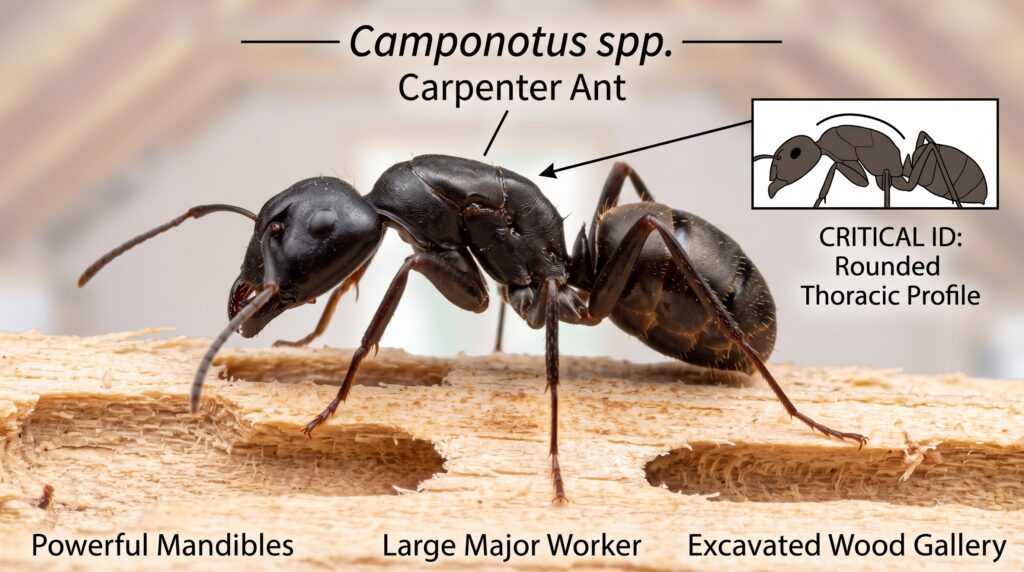
Key feature Big ant whose back forms one smooth arch in side view, with one waist bump
Season Spring to fall; winged swarmers in late spring and early summer
Where Damp wood in window frames, decks, sills, walls and roof edges
What it looks like
Size is the first clue: few ants found in or around Alberta homes are this big. Look at one from the side. The back rises in one smooth arch with no dip or notch, and there is only one small bump at the waist. Workers in the same colony range from medium to very large. Many are jet black, while some show dark red on the middle body. The antennae bend like an elbow.
Winged queens and males appear in spring and early summer. Their front wings are longer than their back wings. The wood is not food for them. Workers carve out living space and dump the chewed fibres outside, so small heaps of coarse sawdust, often mixed with dead ant parts, build up below the nest.
Often confused with
Termite
Field and mound ants (Formica)
Signs to look for
Sawdust piles
Winged ants indoors
Large ants at night
Rustling in walls
Clean tunnels in wood
Risks and damage
Carpenter ants do not sting and are not known to spread disease. Large workers can give a pinching bite if handled, but it is not dangerous. The real concern is wood damage. A colony in a wall, sill or deck slowly hollows out the wood, and damage can build over several years if the nest is left alone. A nest indoors is also a strong hint of a hidden moisture problem, such as a roof, plumbing or window leak.
In Alberta
Carpenter ants are native across Alberta, from the boreal forest to neighbourhoods in Edmonton and Calgary. The Hercules carpenter ant is one of the most often recorded species here. Homes near trees, ravines or parks, and homes with older decks or leaky windows, see them most from spring to fall.
Carpenter ants spend Prairie winters dormant in their nests. Their bodies build up natural antifreeze that helps keep them from freezing, and they become active again when the nest warms in spring.
How to keep them out
Fix leaks and moisture
Move firewood away
Trim trees and shrubs
Remove rotting wood
Seal entry points
When it is time to bring in a professional
Call a professional if you find sawdust piles, see winged ants indoors, or keep finding large ants inside day after day. These signs often mean a nest is hidden in the structure. Technica’s licensed technicians can trace trails back to the nest, look for moisture damage and treat colonies inside and outside the home.
Frequently asked questions
Do carpenter ants eat wood?
No. The wood is only nest space. Workers carve it out and dump the fibres outside. For food, they eat other insects, sweet liquids such as honeydew made by aphids, and scraps they find in homes.
Why am I seeing carpenter ants inside in winter?
Outdoor carpenter ants rest through the Alberta winter. Active or winged ants indoors in winter or very early spring are different. They usually mean the colony is nesting in a warm part of the building. Check walls and floors near any leak.
How serious is carpenter ant damage?
Damage usually builds slowly. A young colony does little harm, but a nest left for years can weaken sills, joists, window frames and deck boards. Finding the nest early, and fixing the moisture that drew the ants in, keeps repairs smaller.