
Identify Your Pest Crawling insects Odorous house ant
Odorous house ant
Tapinoma sessile · Also called: Coconut ant, stink ant, sugar ant
The odorous house ant is a small, dark native ant that gives off a smell like rotten coconut when crushed. It is often noticed as a busy trail along counters, sinks or baseboards, heading for sweet food.
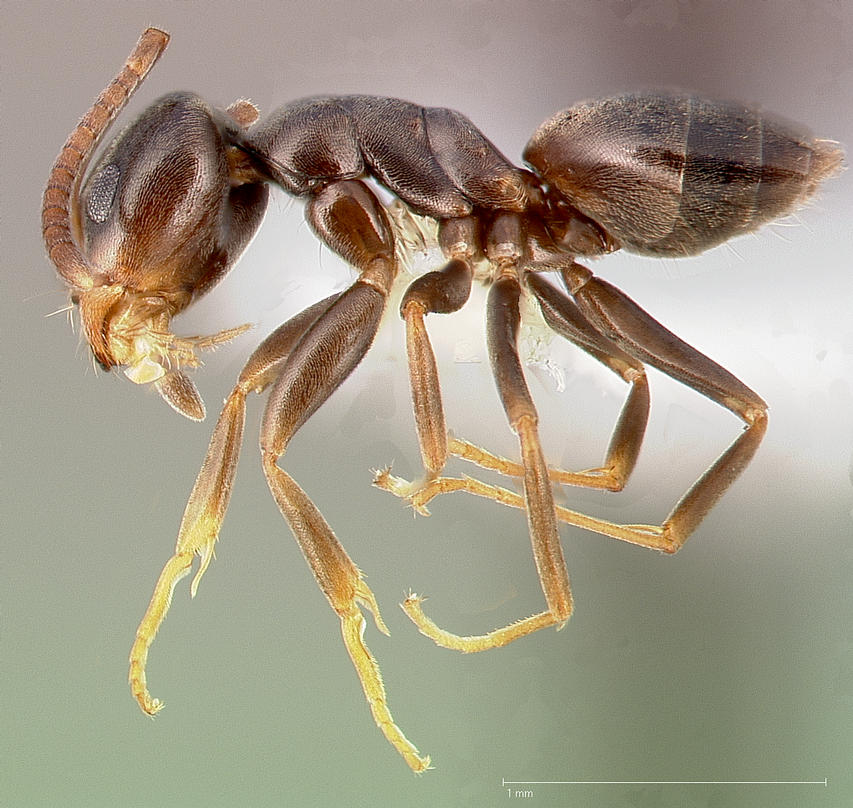
Size Workers about 2.4 to 3.2 mm long
Colour Even brown to black all over
Key feature Smells like rotten coconut when crushed; waist node hidden from above
Season Spring to early fall; often moves indoors after heavy rain
Where Kitchens, bathrooms, wall voids near moisture, and under mulch or stones
What it looks like
Odorous house ants are small and evenly coloured, from brown to nearly black. Workers are all about the same size. The head and thorax look smooth, with no grooves or spines. The waist has one small, flat node that is hidden by the abdomen when you look from above. The body is soft and crushes easily.
The easiest test is the smell. A crushed worker gives off a sour odour that many people compare to rotten coconut. Workers travel in long, wandering trails, often along edges. When disturbed, they run quickly and erratically.
Often confused with
Pavement ant
Pharaoh ant
Turfgrass or cornfield ant
Signs to look for
Long trails along edges
A rotten coconut smell
Trails that move
Ants near moisture
Risks and damage
Odorous house ants are mostly a nuisance. They do not sting, do not damage wood and are not considered a disease risk. The problem is their numbers. City colonies can have many queens and many linked nests, so trails may keep coming back. Workers can get into sweets and other food left out, and food they reach may need to be thrown away.
In Alberta
The odorous house ant is native to Alberta and has been recorded across much of the province, including Edmonton, Calgary and Lethbridge. Outdoors it nests under stones, logs and mulch. It is most often noticed indoors from spring to early fall, when trails move into kitchens and bathrooms.
In the wild, odorous house ant colonies are often small, with a single queen. In cities, the same species can build huge networks of linked nests with many queens, a change researchers have studied closely.
How to keep them out
Seal sweets and food
Wipe up spills fast
Fix leaks and dampness
Clear the foundation
Rinse aphids off plants
When it is time to bring in a professional
Call a professional if trails keep returning after you have cleaned and sealed, if ants show up in several rooms, or if you think they are nesting in a wall. Colonies with many nests are hard to solve by chasing trails. Technica’s licensed technicians can locate the nests and plan a treatment for the whole colony.
Frequently asked questions
Why do odorous house ants smell like coconut?
When crushed, the ants release chemicals they use for defence and to warn each other. Most people describe the smell as rotten coconut or something sour. The odour is harmless, and it is one of the easiest ways to identify this ant.
Are odorous house ants the same as sugar ants?
Sugar ant is a nickname people use for many small ants that go after sweets. The odorous house ant is one of them. Checking for the coconut smell and a hidden waist node helps separate it from other small ants.
Do odorous house ants bite or sting?
They do not sting, and they rarely bite. They are a nuisance rather than a health concern. The main issue is ants in food and on kitchen surfaces.