Identify Your Pest Crawling insects Termites
Termites
Also called: White ants
Termites are small, pale insects that live in colonies and feed on wood. Alberta has one native species, known from dry prairie near Medicine Hat, but building damage is rarely reported, so a suspected termite elsewhere is more likely a winged ant.
Size Workers 3 to 6 mm; swarmers about 10 mm
Colour Workers creamy white; swarmers dark brown to black
Key feature Straight antennae, a thick waist, and four equal-length wings on swarmers
Season Rare in Alberta; subterranean termites swarm mostly in spring
Where Wood touching soil, damp framing, and mud tubes on foundation walls
What it looks like
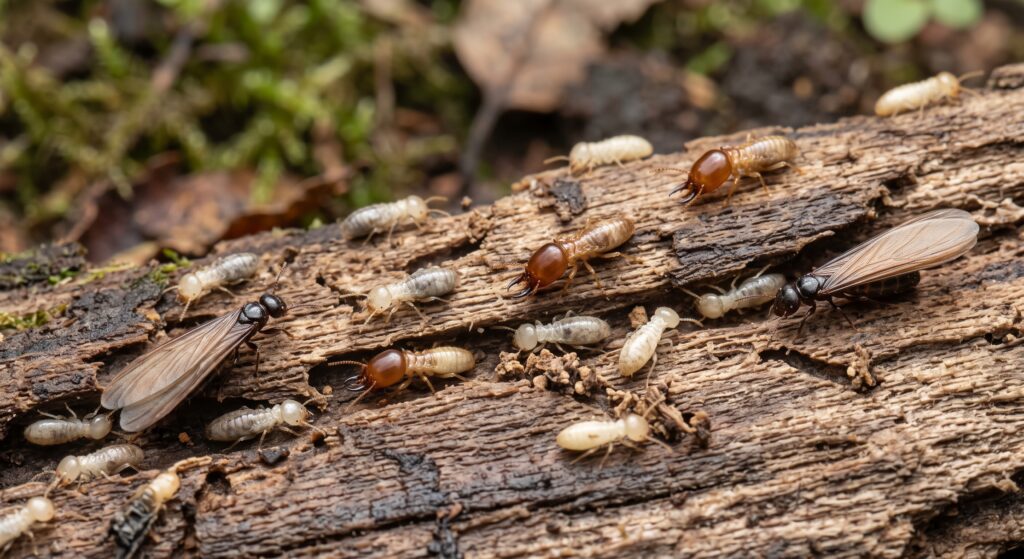
Termites live in large colonies. Most are workers: soft, creamy white insects about 3 to 6 mm long with straight antennae and no pinched waist. They avoid light and stay hidden inside wood or soil. Soldiers look similar but have long, yellowish brown heads and large jaws.
The ones people usually notice are swarmers, the winged adults that leave a mature colony to mate. They are dark brown to black, about 10 mm long including the wings, with a thick waist and straight, bead-like antennae. Their four wings are all the same length, reach well past the body and break off easily. Subterranean termites also build pencil-width mud tubes up foundation walls.
Often confused with
Winged carpenter ant
Other winged ants
Signs to look for
Mud tubes on foundations
Piles of shed wings
Hollow or soft wood
Swarmers indoors
Risks and damage
Termites are not a health risk. They do not sting and are not known to spread disease. Where they are established, they slowly eat the inside of wooden framing, floors and trim, and damage can build over years before anyone notices. In Alberta the risk to homes is low, since the native termite is known from dry prairie near Medicine Hat. Damaged wood in Alberta homes is more often caused by carpenter ants or moisture rot.
In Alberta
Alberta has one native termite, the arid land subterranean termite, which the province’s species database lists as present. Known finds come from dry prairie near Medicine Hat and Redcliff, including an old record of a small infestation. Termites are not known in Edmonton, Calgary or Red Deer.
Termites are close relatives of cockroaches. Genetic studies led scientists to place termites inside the cockroach order, Blattodea, as a group of highly social cockroaches.
How to keep them out
Break wood-to-soil contact
Control moisture
Store firewood away from the house
Check used wood before using it
When it is time to bring in a professional
Call a professional if you see mud tubes on the foundation, soil-packed tunnels in wood, or insects with four equal-length wings indoors. Termite damage is rarely reported in Alberta, so a confirmed find is worth acting on quickly. Technica’s licensed technicians can tell termites from carpenter ants or wood rot.
Frequently asked questions
Are there termites in Alberta?
Yes, but they are seldom seen. The province lists one native species, the arid land subterranean termite. Termites have been found in old wood near Redcliff, and an old record describes a small infestation in Medicine Hat. Termites are not known in Edmonton, Calgary or Red Deer, where a winged ant is a likelier find.
How can I tell a termite from a winged ant?
Check three things. Termites have a thick waist, straight antennae and four wings of equal length. Ants have a narrow, pinched waist, bent antennae and front wings that are longer than the back wings. A clear close-up photo usually shows all three.
Can termites reach Alberta in firewood or lumber?
It is possible. Termites can be moved in infested wood, soil and landscape timbers, and people moving these materials is one way termites have reached new areas. Buy firewood close to where you burn it, and inspect used wood before bringing it home.