
Identify Your Pest Crawling insects Boxelder bug
Boxelder bug
Boisea trivittata · Also called: Box elder bug, eastern boxelder bug
The boxelder bug is a black and red insect that feeds mainly on the seeds of Manitoba maple trees. It is noticed in late summer and fall, when large groups gather on sunny walls and slip indoors to spend the winter.
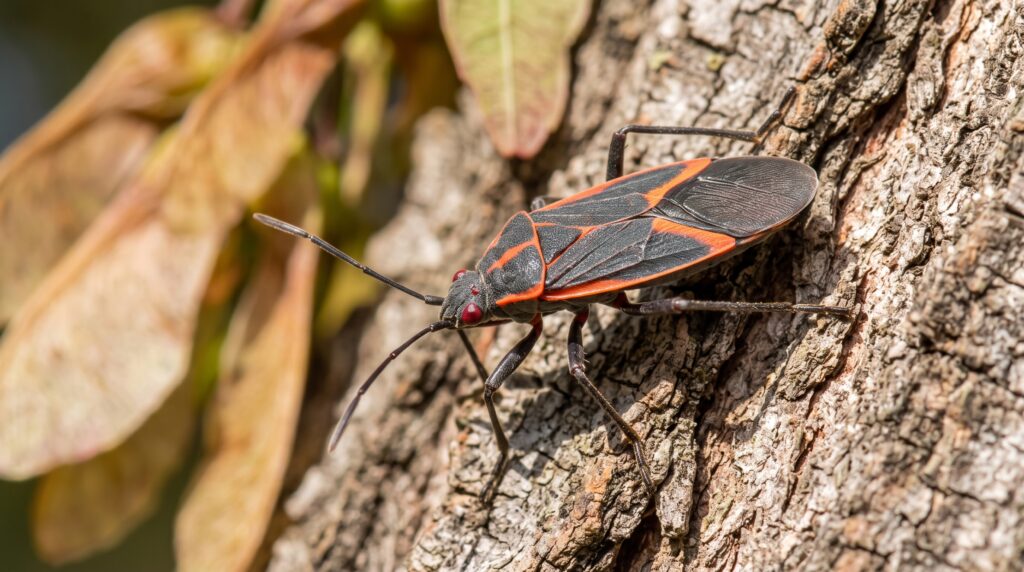
Size About 12 to 14 mm long
Colour Mostly black, trimmed in red; young ones are mostly red
Key feature Three red stripes behind the head and thin red edges on the wings
Season Late August to October outside; warm winter and spring days indoors
Where Sunny south and west walls, window frames, attics and wall voids
What it looks like
Adult boxelder bugs are flat, narrow and mostly black. Look for thin red trim along the wing edges and three red or orange lines on the section just behind the head. When the wings open, a bright red abdomen shows underneath.
Nymphs, the young stage, have no working wings yet. They are mostly bright red, which makes them easy to spot on tree trunks. Adults and nymphs are often seen together on Manitoba maple trees in summer. In fall they gather in large groups on warm, sunny walls.
Often confused with
Western conifer seed bug
Clover mite
Signs to look for
Clusters on sunny walls
Bugs indoors on warm days
Small orange stains
Nymphs on maple trees
Risks and damage
Boxelder bugs are a nuisance, not a danger. They do not sting or spread disease, and they rarely if ever bite people. They do not breed indoors or chew wood, food or fabric. Their droppings can leave small reddish orange spots on curtains, walls and light fabrics, and crushed bugs give off an unpleasant smell. Feeding damage to trees is minor.
In Alberta
Boxelder bugs are common in Alberta wherever Manitoba maples grow, including many neighbourhoods in Calgary and Edmonton. They gather on sunny walls from late August to October. Warm spells in winter and spring can bring hidden bugs out into rooms.
Boxelder bugs feed mostly on the seeds of female Manitoba maples. Male trees do not make seeds, so homes near seed-bearing trees tend to see the most bugs.
How to keep them out
Seal gaps before late August
Add door sweeps
Vacuum, do not crush
Clean up seeds and debris
Choose trees with care
When it is time to bring in a professional
Consider professional help if boxelder bugs return in large numbers every fall, if many are getting into attics or wall voids, or if they keep appearing in rooms all winter. High or hard-to-reach gaps are easier to seal with help. Technica’s licensed technicians can inspect your home and suggest the right approach.
Frequently asked questions
Do boxelder bugs bite or damage my home?
They rarely if ever bite people, and they do not damage wood, insulation or food. The main problems are small stains from their droppings and the smell of crushed bugs.
Will boxelder bugs lay eggs in my house?
No. They do not breed indoors. They hide in walls and attics to survive the winter, then try to get back outside in spring to feed and lay eggs on host trees.
Why do they show up inside in the middle of winter?
Bugs sheltering in walls and attics can become active when sun or indoor heat warms their hiding spot. They then wander toward light and windows. They cannot breed indoors and slowly die off.