Identify Your Pest Crawling insects Pavement ant
Pavement ant
Tetramorium immigrans · Also called: Immigrant pavement ant
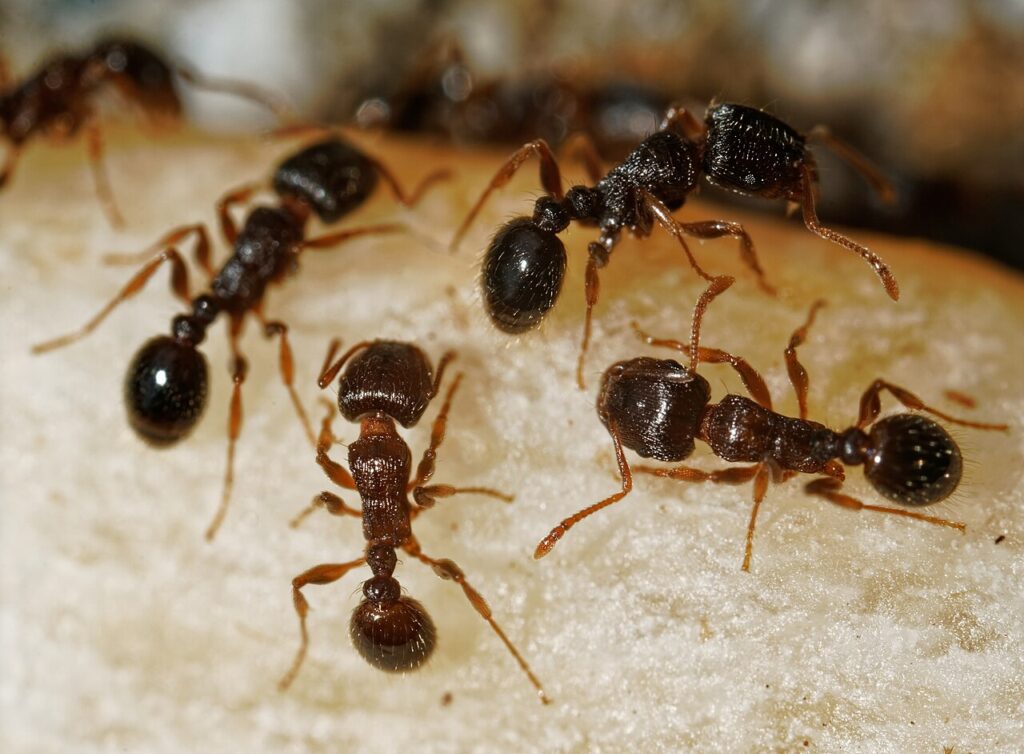
Pavement ants are small, dark ants that live in the soil beneath concrete, such as walkways, parking pads and basement floors. They are rare in Alberta, so most small ants seen along local sidewalks turn out to be native species.
Size Workers about 2.5 to 4 mm long
Colour Dark brown to black; legs a little lighter
Key feature Lengthwise ridges on head and thorax; two bumps where the waist narrows
Season Spring to fall; indoors in winter if nesting under a heated slab
Where Cracks in sidewalks, driveways, patios, slabs and foundation edges
What it looks like
Pavement ants are small, dark ants that move in steady trails. Workers in a colony are all about the same size. Under a hand lens, fine ridges run lengthwise over the head and thorax, while the rear abdomen is smooth and shiny. Two short spines point backward just before the waist, which has two small bumps, called nodes.
Winged queens and males look like larger, darker versions of the workers. The easiest field sign is the nest. Pavement ants push out small piles of loose soil or sand along sidewalk cracks, driveway edges and the gaps where a slab meets a wall.
Often confused with
Odorous house ant
Turfgrass or cornfield ant
Native Myrmica ants
Signs to look for
Soil piles along cracks
Trails to food
Ant wars on concrete
Ants indoors in winter
Risks and damage
Pavement ants are mostly a nuisance. They do not chew wood or damage building materials, and they are not aggressive toward people. They can bite or sting if handled, but this is rarely noticed. Indoors, they feed on crumbs, grease, sweets and pet food, so they can get into food that is left out. The soil they push up through cracks is untidy but is not a sign of structural damage.
In Alberta
Pavement ants are not widespread in Alberta. They were not listed in a 2013 scientific key to Alberta’s ants, and recent recorded sightings are few, mostly from Calgary and Medicine Hat. Many small ants nesting in Alberta sidewalks are native species, so a close look matters.
North American pavement ants were long called Tetramorium caespitum. In 2017, researchers showed they are a separate species, now named Tetramorium immigrans, a name that points to their travels with people.
How to keep them out
Seal cracks and gaps
Clean up crumbs and grease
Store food sealed
Watch the slab edges
When it is time to bring in a professional
Call a professional if ants keep coming indoors after you have cleaned up and sealed gaps, or if they stay busy indoors all winter. A colony under a slab is hard to reach. Because several small Alberta ants look alike, Technica’s licensed technicians can confirm which ant you have and treat the nest at its source.
Frequently asked questions
Are pavement ants common in Alberta?
Not very. They are well known in many North American cities, but in Alberta they have been recorded in only a few places, mostly in the south. Many small sidewalk ants here are native species. A clear close-up photo helps confirm what you have.
Why do pavement ants fight on sidewalks?
Each colony guards the ground around its nest. When workers from two colonies meet, usually in spring or summer, many more join in. Most pair off and grapple, sometimes for hours, but very few are killed. The crowd breaks up on its own, and the clash is harmless to people.
Do pavement ants damage concrete or foundations?
No. They nest in the soil under and beside slabs and push that soil up through cracks that are already there. They do not chew concrete or wood. The soil piles are a useful clue to where the nest is.