
Identify Your Pest Crawling insects Larder beetle
Larder beetle
Dermestes lardarius · Also called: Bacon beetle
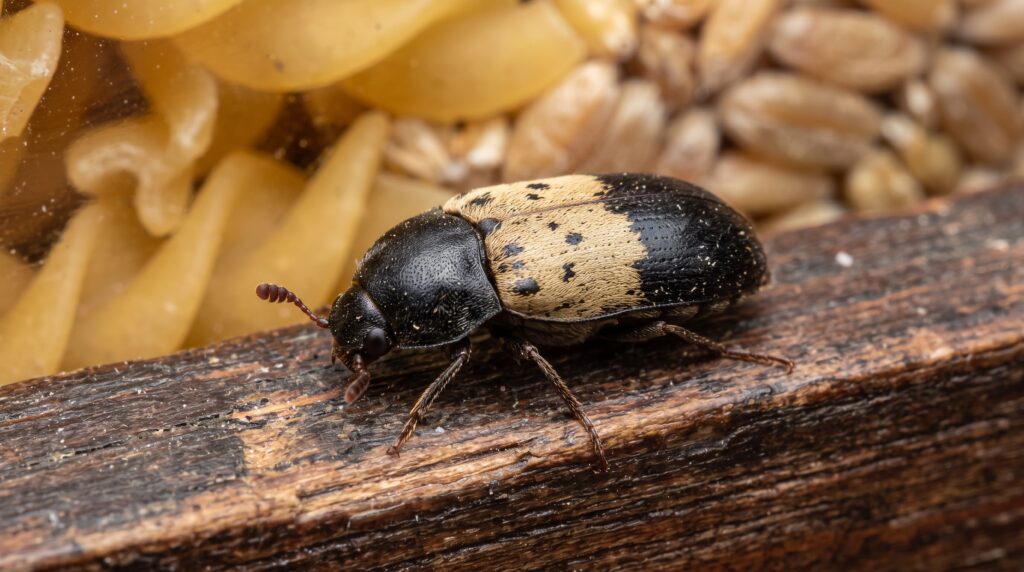
The larder beetle is a dark, oval beetle with a pale band across its back that feeds on dried meat, pet food and dead insects or animals. In Alberta, most people notice the adults indoors in spring, often near windows, lights or the pantry.
Size Adults 7 to 9 mm; larvae up to about 13 mm
Colour Black or deep brown, crossed by a dusty yellow band
Key feature Pale band across the front of the back holding about six dark spots
Season Adults mostly May and June; larvae in late spring and summer
Where Pantries, pet food, windowsills, light fixtures, attics and wall voids
What it looks like
Adults are 7 to 9 mm long, oval and dark brown to black. Look for a light stripe that crosses the back just behind the thorax. It is dusty yellow to grey and dotted with about six small dark spots, three on each side. Adults can fly and often end up at windows or lights.
Larvae are brown, bristly grubs that grow to about 13 mm. Under a magnifier you can see a pair of tiny hooks pointing up from the rear end. Full-grown larvae leave their food to find a safe place to change into adults. They may chew small, round tunnels into wood trim, drywall, insulation or cardboard to do it.
Often confused with
Carpet beetle
Black larder beetle
Cockroach
Signs to look for
Beetles near windows in spring
Hairy larvae and shed skins
Small round holes
Damaged pet food
Activity near dead insects
Risks and damage
Larder beetles do not bite, sting or spread disease. The main problems are spoiled food and small holes. Larvae get into pet food, dried meats and other animal-based products, leaving hairs and shed skins behind. When they bore into wood, drywall or insulation to change into adults, the damage is usually minor. Repeated sightings can also point to a dead mouse or bird hidden in a wall or attic.
In Alberta
Larder beetles turn up in homes across Alberta, including Edmonton and Calgary. City of Edmonton advice puts peak adult activity in May and June. Adults hunt for protein to lay eggs on, and in Alberta homes that is often a pile of dead cluster flies in an attic, an old nest or a dead mouse.
Museums and universities keep colonies of the hide beetle, a cousin of the larder beetle, to prepare skeletons. The larvae eat dried tissue off the bones and leave even tiny bones in place.
How to keep them out
Store pet food sealed
Clean up dead insects
Clean up grease and scraps
Remove old nests
Seal entry points
When it is time to bring in a professional
Call a professional if larvae keep appearing after cleaning, if you find holes in wood or drywall, or if you suspect a dead animal inside a wall or attic. Finding and removing the food source is the key to stopping them. Technica’s licensed technicians can track down the source and treat hidden areas.
Frequently asked questions
Are larder beetles harmful to people?
No. They do not bite, sting or carry disease. The concern is contaminated food and minor damage from larvae boring into materials. Throw out any food that has larvae or shed skins in it, and check nearby packages too.
Why do I see larder beetles every spring?
Adults spend winter in sheltered spots in walls, attics or outdoors. As days warm up, they become active and look for places to lay eggs. A few each spring is not unusual in Alberta, but steady numbers suggest a food source inside the home.
Can larder beetles damage my house?
Larvae do not eat wood, but mature larvae may bore into wood, drywall, insulation or cork to make a safe place to change into adults. The holes are small and the damage is usually minor, but many holes in one area suggest a large, long-running infestation.